Support our community to restore Taranaki's natural environment
We can’t do it alone. We need your help! Any money you donate will go directly to supporting Taranaki projects restoring and protecting biodiversity. You get to choose where it goes to. And if you can’t help out with cash, you can help in other ways.
Beyond the Graphs
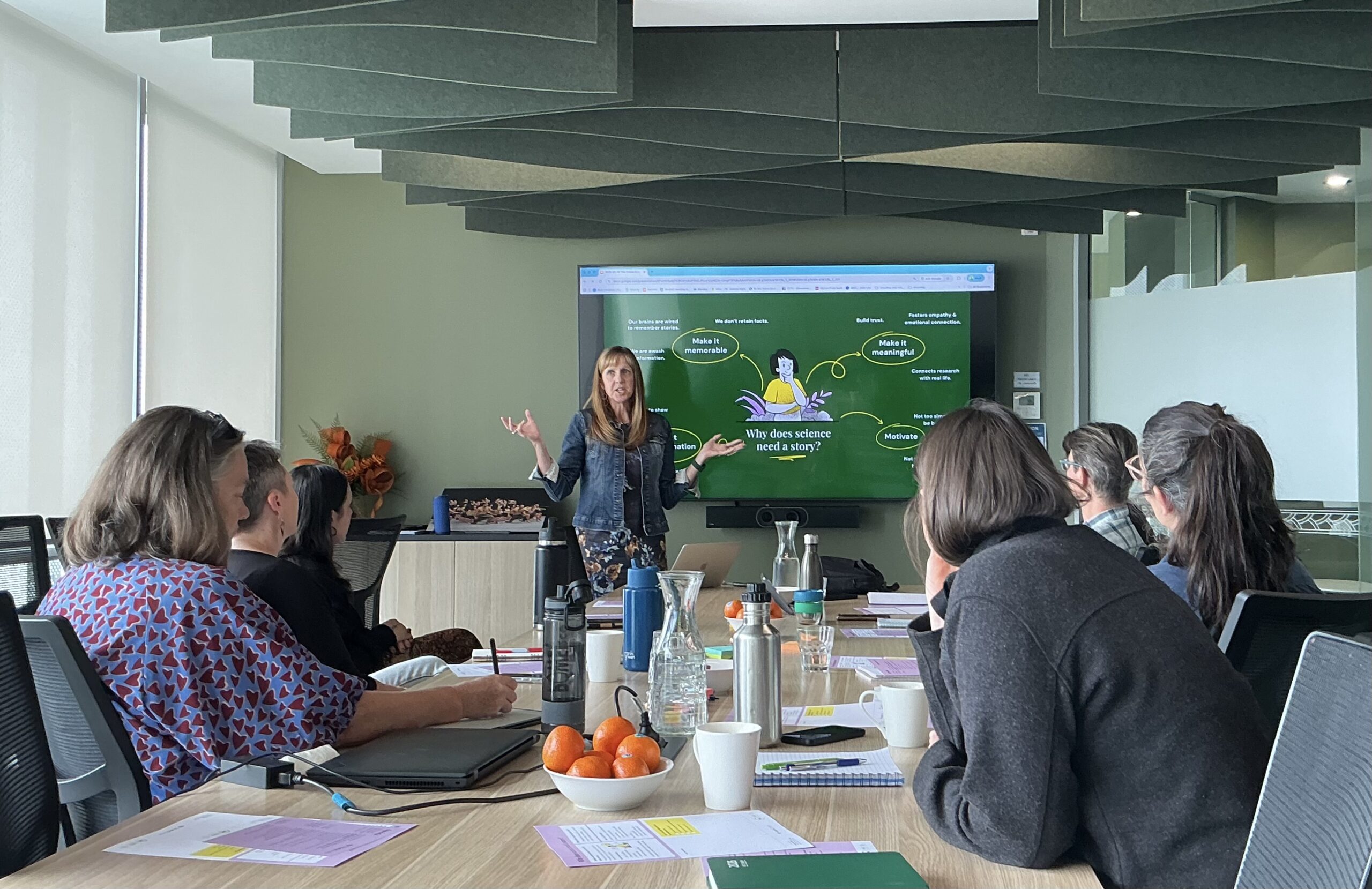
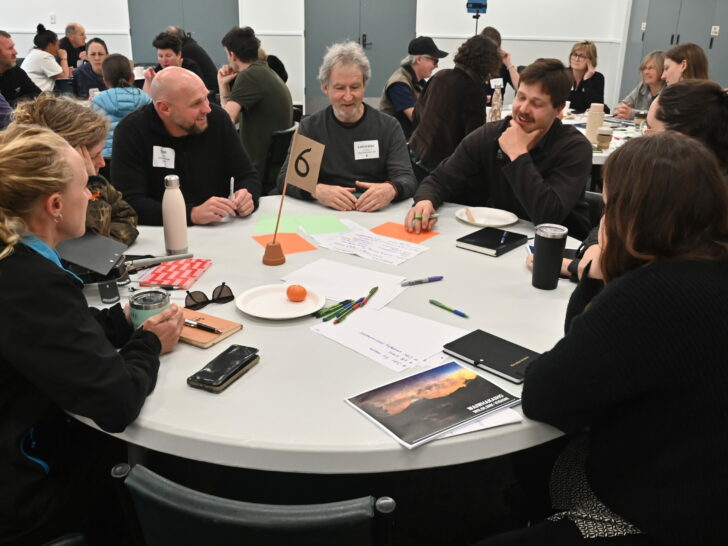
We were fortunate to host Laura Sessions, from StudioC to present a workshop Beyond the Graphs — a fresh approach to sharing science through the power of storytelling. Developed by StudioC Design, this framework helps researchers move beyond data-heavy communication and connect meaningfully with their audiences. Science is often presented through graphs, numbers, and technical language—but our brains are wired to remember stories, not isolated facts. Storytelling makes science memorable, builds trust, and creates emotional connections that inspire action. In a world saturated with information, a well-told story helps research stand out and feel relevant to everyday life.
At its heart, a good science story includes three key elements: relatable characters, a sense of action or discovery, and a clear impact to explain why people should care. It follows a simple 3-part narrative—beginning, middle, and end—guiding the audience from setting the scene, through a twist or a challenge, to a resolution or punchline. Importantly, storytelling doesn’t require groundbreaking results; even small insights can be powerful when framed well.
It was powerful to do the FIVE WHYS to better understand the problem or why people should care about our mahi:
1. What is the problem that you are trying to resolve?
e.g. We want to protect kererū from further decline
2. Why is this important?
e.g. Kererū are under threat from introduced pests and habitat destruction
3. Why does this matter?
e.g. Kererū are important native species that are taonga, and unless we protect them, they will continue to decline.
4. Why is this important?
e.g. They are the only native birds left in Aotearoa that can swallow the fruits of certain trees. Without kererū, certain native plants will not be able to spread their seeds.
5. So why should people care about this?
e.g. Kererū are an important part of a native forest regeneration, and without them, our forest ecosystems will not be able to function as they should.
A uniquely Aotearoa perspective also brings together mātauranga Māori and science. By focusing on shared kaupapa—such as restoring the health of an awa—storytelling can bridge knowledge systems, weaving together concepts like whakapapa and ecosystem health into one meaningful narrative.
Ultimately, storytelling transforms data into something people care about. It answers not just “what happened,” but “so what?” and “what next?”—turning science into action, understanding, and impact.
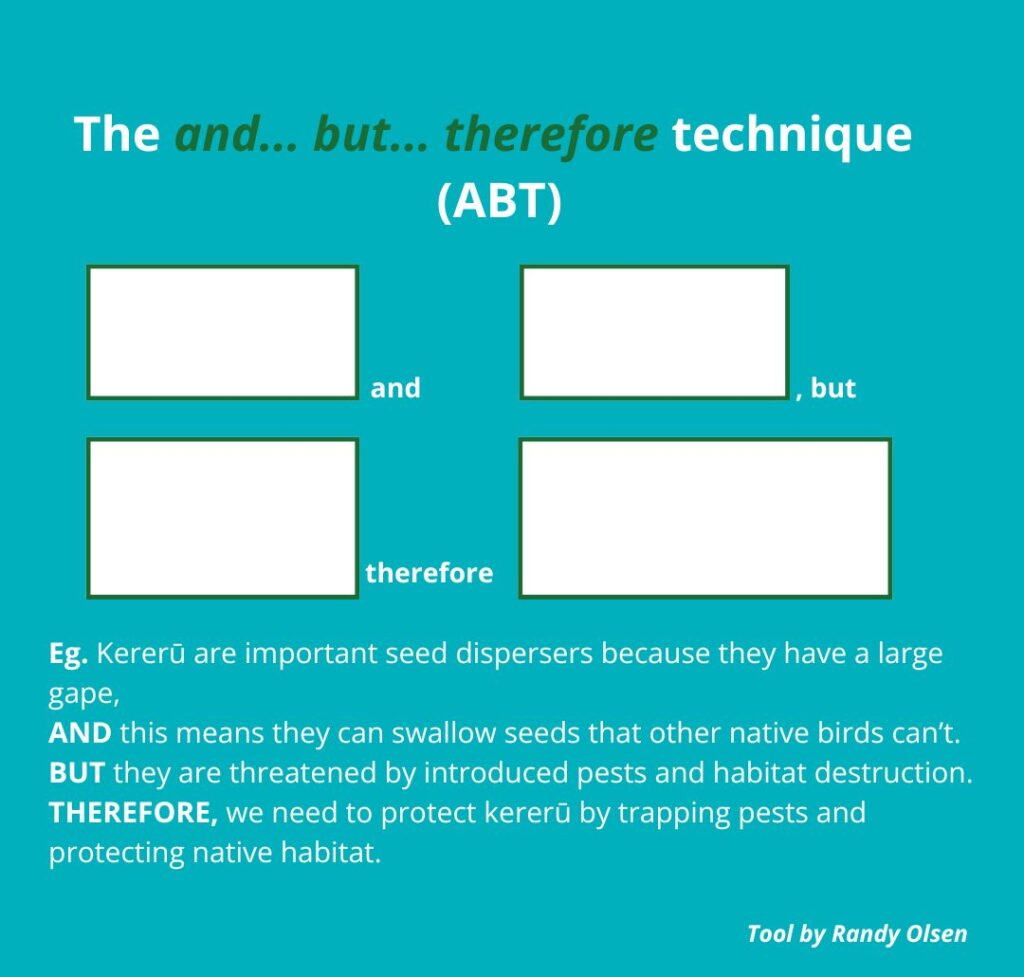
One tool the participants really enjoyed was the And …But…Therefore (ABT) Technique by Randy Olsen.
Feedback from workshop participants said;
“Overall, this is the best training/workshop I have done in ages, thank you!”
” The whole session was amazing and helped me perceive storytelling in a new light. One of excitement and potential! The ‘and, but, therefore’ technique will be extremely useful as we start to lean into more content creation and storytelling to capture the right audience in a fun and digestible way!”
” A very focused and yet dynamic workshop.”
” The day was great, I wouldn’t change a thing, thank you – beautiful resources & presentation.”
Now, over to you!