Support our community to restore Taranaki's natural environment
We can’t do it alone. We need your help! Any money you donate will go directly to supporting Taranaki projects restoring and protecting biodiversity. You get to choose where it goes to. And if you can’t help out with cash, you can help in other ways.
# 2 BIODIVERSITY CORRIDORS HUI
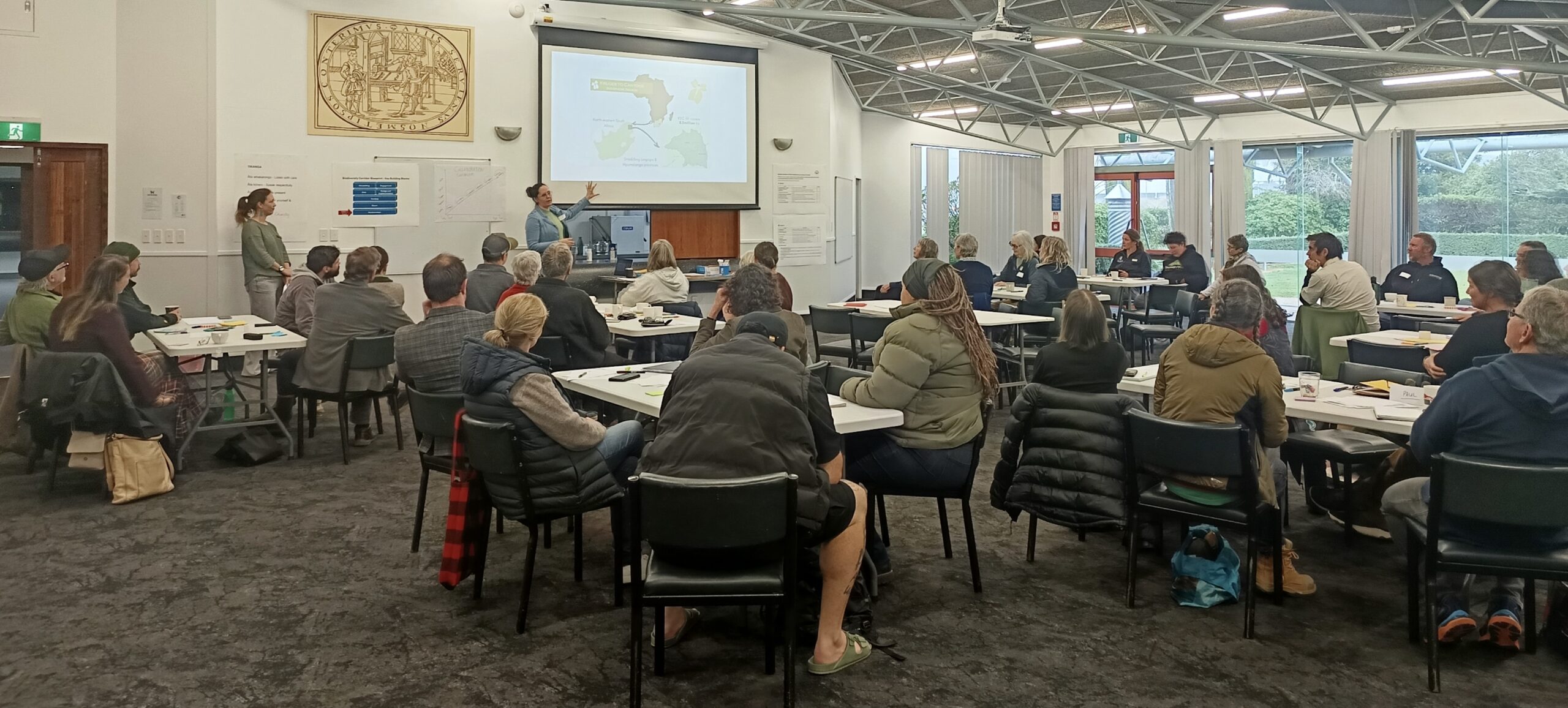
Our Biodiversity Corridors Hui 2025 brought together people from across the region to share knowledge, explore the mahi already underway, and build collective ambition for restoring biodiversity corridors across Taranaki. We examined the enablers and barriers influencing our progress, and we were inspired by insights from Sera Gibson and Professor Bruce Clarkson, whose work along the Waiwhakaiho demonstrated what becomes possible when communities, mana whenua, and organisations unite around a shared vision.
A clear theme emerged: the biggest barriers and enablers weren’t only technical or ecological, they were relational. They centred on how we communicate, align, collaborate, and maintain momentum over time.
Building on that insight, our second hui turned the focus inward. This hui was about us: the networks, organisations, and partnerships that make biodiversity corridor work possible. If we want enduring, intergenerational outcomes for te taiao, we need to keep strengthening how we work together.
So we asked ourselves: How can we shape our sector, so we are able to progress successful, enduring biodiversity corridors in Taranaki? What behaviours, habits, systems, and ways of working help us succeed, and which ones may unintentionally hold us back?
Our aspiration is to create the conditions where biodiversity corridor work becomes commonplace, successful, and enduring across the region.
Our Collective Vision
Together, we crafted a vision statement describing what our sector will look and feel like five years from now, when biodiversity corridors are thriving:
We are a connected and ambitious sector that prioritises te taiao, values diverse strengths and perspectives, and works collectively to achieve thriving biodiversity corridors across Taranaki.
Guiding Principles for How We Work Together
To bring this vision to life, we identified the principles that will guide our day‑to‑day collaboration in practice and in spirit:
- Recognise, acknowledge, elevate, support & celebrate champions
- Project focus & communication: keep each other informed; keep the public informed
- Identify gaps and ask for help
- Be courageous — Tūwhitia te hopo, mairangatia te angitū / Cast aside fear, elevate success
- Share information with purpose
- Prioritise and make time for this kaupapa
These principles reflect the behaviours that strengthen trust, build momentum, and support collective action.
One of the commitments from our first hui was to develop a sector‑wide skills matrix. Throughout Hui #2, participants contributed to our “wall of capabilities and needs,” helping us map the strengths we already have and the gaps we need to address.
Sector Skills, Capabilities & Needs
Capabilities
Across Taranaki’s biodiversity sector, there is a deep and diverse pool of expertise spanning research, education, restoration, and community engagement.
Our partners bring complementary strengths: ecological science, species monitoring, environmental planning, relationship building, facilitation, and large‑scale project delivery. Technical capability (mapping, data management, pest control, biosecurity, wetland restoration) sits alongside strong social and cultural capability (networking, communication, mātauranga Māori, collaboration across iwi, community, and government).
Together, these capabilities form a connected, multidisciplinary network able to plan strategically, act collectively, and deliver enduring outcomes for te taiao.
Needs
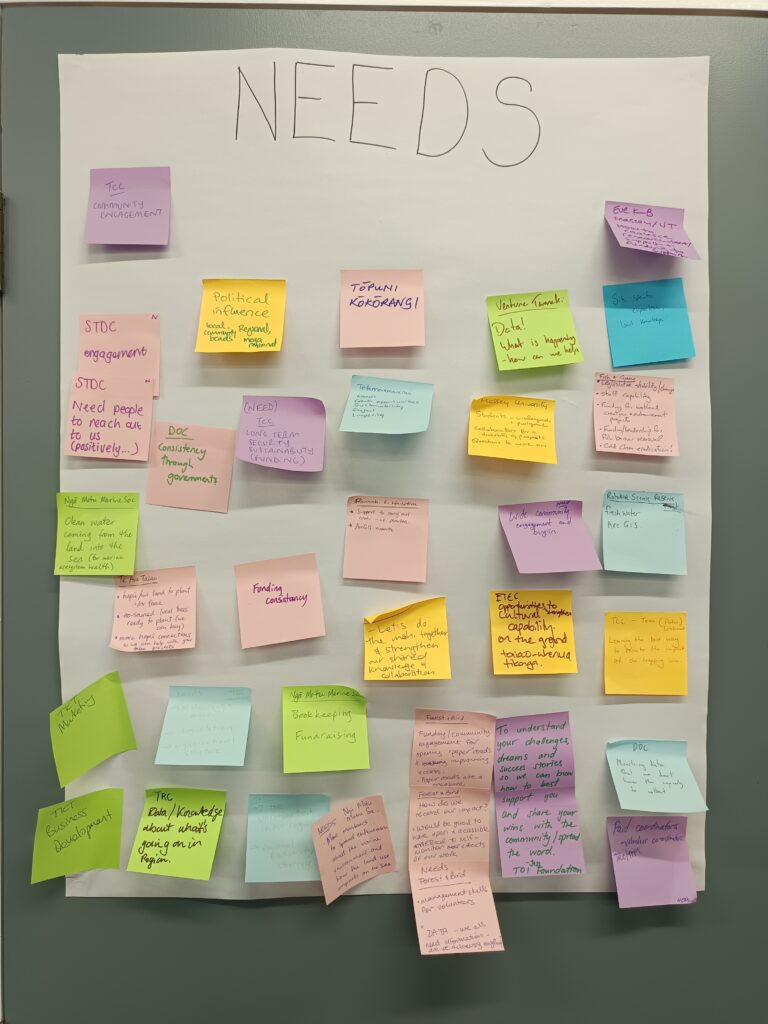
Participants also highlighted several needs essential for long‑term, collaborative action:
- Stronger engagement and coordinated leadership
- Consistent, reliable funding
- Trust‑based communication between communities, hapū/iwi, councils, and organisations
- Political support and legislative stability
- Better data and knowledge exchange
- Site‑specific expertise and pathways to connect research talent with on‑the‑ground projects
- Strengthened cultural capability
- Celebrating collaboration and ensuring wide community participation
These needs reflect the conditions required for sustainable, intergenerational progress.
What’s Coming Next
We are currently in the information gathering phase to create a regional needs assessment, which will inform the steps that follow.
Alongside this, we are:
– Continuing one-on-one and smaller group engagement across the region
– Developing mechanisms for shared capacity, expertise, and support
– Building purposeful means for information sharing
– Undertaking mapping that includes relevant ecological data and communities of interest
– Recognising, acknowledging, elevating, supporting & celebrating champions
This groundwork will allow us to develop clear strategic priorities and a tiered roadmap for the corridors work ahead.